
Your Problem Isn’t Food Noise. It’s Self-Abandonment.


Paige Elizabeth
Founder and Coach
If you’re honest with yourself, you already know this isn’t really about food.
t isn’t alcohol.
It isn’t cigarettes.
It isn’t shopping.
It isn’t overworking.
It isn’t being a “pick-me.”
It isn’t needing one more achievement, one more milestone, or one more dollar to finally feel okay.
Those things are not the problem.
They are symptoms.
Symptoms of a nervous system that never learned how to feel safe inside itself.
Symptoms of self-abandonment that started long before willpower was even a concept.
Symptoms of living disconnected from your internal authority.
When the system is dysregulated, we don’t turn inward — we outsource regulation. We reach for something outside of ourselves to soothe, distract, numb, validate, or stabilize us. Food. Alcohol. Approval. Productivity. Money. Control. Different behaviors, same function.
They all stand in for something we stopped giving ourselves a long time ago: presence, safety, and self-trust.
The Discipline Myth
We’ve been sold the idea that if we could just be more disciplined, everything would fall into place.
Eat less.
Move more.
Drink less.
Spend less.
Work harder.
Want less.
But discipline doesn’t address the real question, which is this:
Why does being alone with yourself feel intolerable in the first place?
If your nervous system learned early on that it wasn’t safe to slow down, feel, or rest inside your own body, then discipline becomes a form of self-violence. You override hunger. You override exhaustion. You override intuition. You override discomfort.
You don’t trust yourself — so you control yourself.
And control works… until it doesn’t.
Why External Fixes Only Work Temporarily
This is why external strategies feel amazing at first and then slowly lose their power.
A new diet quiets food noise — until it doesn’t.
A GLP-1 suppresses appetite — until your system adapts.
Sobriety feels stabilizing — until the underlying dysregulation resurfaces.
Achievement gives relief — until the next void appears.
None of these are failures. They’re clues.
They’re telling you the same thing over and over:
Band-aids never become cures.
If the relationship to yourself hasn’t changed, relief will always be temporary. The behavior might shift, but the pattern stays intact. You simply trade one coping mechanism for another that looks more socially acceptable.
Self-Abandonment Is the Root
Self-abandonment doesn’t always look dramatic. Often, it looks responsible, productive, successful.
It looks like:
– ignoring your body’s signals
– staying in conversations that drain you
– pushing through exhaustion because “you should be able to handle it”
– overriding your own no to maintain approval
– using achievement as proof of worth
At some point, many of us learned that staying with ourselves was unsafe.
Maybe it led to punishment, rejection, overwhelm, or abandonment. So we adapted. We learned to leave ourselves before someone else could.
The problem isn’t that you reach for food, alcohol, money, control, or approval.
The problem is that you learned you couldn’t stay.
Regulation Changes Everything
When the nervous system becomes regulated, something remarkable happens.
You don’t need to force better choices.
They happen organically.
You don’t punish your body into being lean — you care for it.
You don’t white-knuckle sobriety — you no longer need escape.
You don’t chase approval — you govern from internal authority.
You don’t overconsume — you’re already nourished.
A regulated system doesn’t need coping mechanisms to survive. It makes decisions from clarity instead of urgency.
This is the piece that most “fix-it” approaches miss.
Real change doesn’t come from more control.
It comes from connection.
Internal Authority vs. External Regulation
When you live disconnected from your internal authority, you rely on external regulators:
– rules
– substances
– validation
– productivity
– numbers on a scale or bank account
When you live connected to internal authority, your system self-regulates. You don’t need constant management.
You don’t need to bargain with yourself. You don’t need to override your instincts.
You trust yourself.
And when you trust yourself, life becomes simpler — not easier, but clearer.
The Question That Changes the Pattern
So the next time you feel the urge to reach for something — a GLP-1, a drink, a purchase, another achievement, or someone else’s approval — pause.
Not to shame yourself.
Not to stop yourself.
But to get curious.
Ask yourself:
Why am I so unwilling to sit with the part of myself that needs me to see her — and hear her?
That question isn’t an accusation.
It’s an invitation.
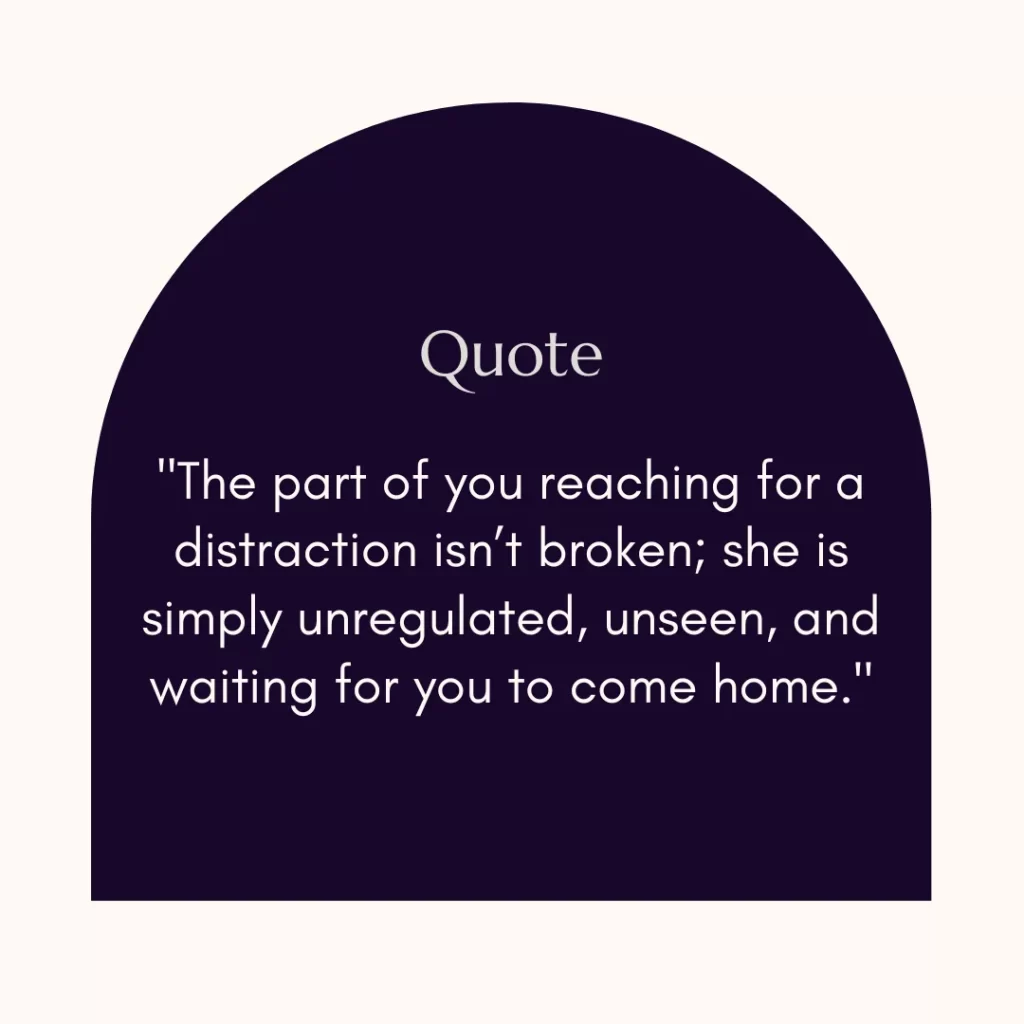
Because the part of you reaching isn’t broken.
She’s unregulated, unseen, and unsupported.
And no amount of external control will ever replace internal safety.
Healing Isn’t About Fixing Yourself
You don’t heal by becoming someone else.
You heal by stopping the pattern of leaving yourself.
By learning how to stay present when discomfort arises.
By repairing the relationship with your body instead of managing it.
By building internal authority instead of outsourcing it.
When that relationship shifts, behaviors reorganize naturally.
No force.
No punishment.
No endless maintenance.
Just alignment.
If This Resonates
If you’re tired of cycling through the same patterns in different disguises…
If you want peace around food, money, relationships, and success…
If you’re ready to stop managing symptoms and start repairing the root…
This is the work.
And it’s not about doing more.
It’s about coming home to yourself.
When you stop abandoning yourself, everything else finally has somewhere to land.
Stop Managing the Symptom. Start Healing the Root
If you’ve spent years trying to “discipline” your way into a better life only to end up back where you started, you don’t need more willpower—you need a way back to yourself.
I help high-achievers and seekers move from constant self-abandonment to deep, internal safety. Let’s look at what’s happening beneath the surface and build a nervous system that finally knows how to stay.
LIKE THIS ARTICLE? Share on
Facebook
Twitter
LinkedIn