
Healing Your Nervous System Gives You Your Time Back — Literally


Paige Elizabeth
Founder and Coach
Most people don’t need better time management.
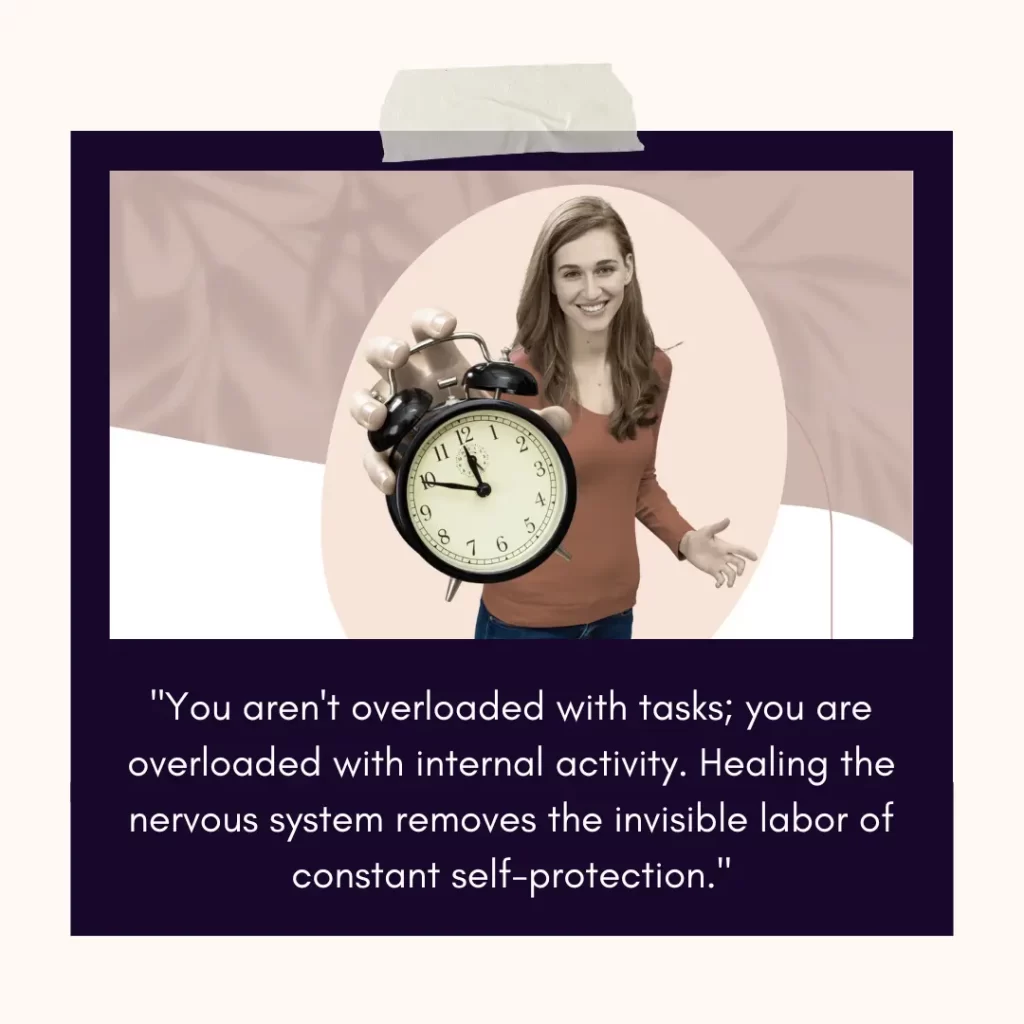
They need their nervous system to stop hijacking their day.
Because when your nervous system is dysregulated, time leaks everywhere — and you don’t even realize it’s happening.
Not on your calendar.
Not in obvious ways.
But in the spaces between moments.
That’s where your life is being spent.
The "Busy" Lie: A Sign of a Dysregulated Nervous System
People say they’re busy like it’s a badge of honor.
But if you slow it down and actually look at how most days are spent, the truth is uncomfortable:
Most people are not overloaded with tasks.
They are overloaded with internal activity.
thinking about what just happened
worrying about what might happen
replaying conversations
rehearsing future ones
bracing for outcomes
scanning for threats
clinging to certainty or control narratives
That mental activity consumes hours.
And it happens simultaneously with everything else — which is why people feel like time is disappearing.
How a Dysregulated Nervous System Fragments Your Time
When the nervous system is dysregulated, attention fractures.
You can be:
working while worrying
resting while ruminating
exercising while bracing
eating while planning
So a 30-minute task quietly turns into:
20 minutes of thinking before
30 minutes of doing
45 minutes of mental processing after
The task didn’t take longer.
Your nervous system did.
Multiply that by every interaction, decision, and responsibility, and suddenly people are “busy” all day without actually being present for much of it.
Why Productivity Hacks Fail Without Nervous System Healing
You can optimize your schedule endlessly.
But if your nervous system is in survival mode, all you’re doing is rearranging stress.
Survival-mode nervous systems:
rush even when there’s no urgency
overthink simple decisions
need certainty before acting
struggle to complete emotional loops
stay mentally activated long after events end
That doesn’t just cost energy — it costs time.
The Transformation: What Happens During Nervous System Healing
When regulation begins to return, the first noticeable change isn’t calm.
It’s efficiency without effort.
People start saying things like:
“I don’t know how, but my days feel longer.”
“I’m getting things done faster without pushing.”
“I don’t need as much recovery time.”
“I have evenings again.”
What’s happening is simple:
Internal drag disappears.
Tasks start and end where they’re supposed to.
Conversations don’t replay.
Decisions don’t echo.
Moments finish.
Presence collapses wasted time
A regulated nervous system does one thing at a time.
That alone gives hours back.
When you’re present:
work takes the time it actually takes
emotions move through instead of looping
boundaries don’t require rehearsals
rest actually restores you
This isn’t spiritual.
It’s neurological.
When the nervous system no longer perceives constant threat, it stops preparing for disasters that never arrive.
That preparation is where most people’s time goes.
You’re not “too busy” — you’re mentally occupied
This is the reframe people resist the most.
Because “busy” sounds external and uncontrollable.
But most time loss is internal.
You’re not overwhelmed because there’s too much to do.
You’re overwhelmed because your nervous system is trying to manage reality instead of inhabit it.
That’s why people can:
finish a day exhausted without doing much
take time off and still feel drained
lie down and not rest
complete tasks but never feel done
Healing doesn’t add hours to the day.
It removes the invisible labor of constant self-protection.
Control narratives are the biggest time thief
One of the largest drains on time is the mind’s insistence on certainty.
A dysregulated nervous system asks:
“What does this mean?”
“How do I make sure this doesn’t happen again?”
“What’s the right move?”
“What if I get it wrong?”
Trying to control outcomes before they exist is where people lose entire days.
When regulation returns, uncertainty becomes tolerable.
Not because life is safer — but because your body no longer requires prediction to feel okay.
That alone frees up enormous amounts of time.
Why Nervous System Healing Feels Uncomfortable at First
Early in nervous system healing, people often feel slower.
Less driven.
Less urgent.
Less “on.”
That’s because urgency was never motivation — it was adrenaline.
When adrenaline drops:
time expands
perception deepens
rushing loses its grip
This is often misinterpreted as laziness or loss of edge.
It’s neither.
It’s the absence of panic.
And once the body adjusts, what replaces urgency is:
clarity
decisiveness
sustained energy
real productivity
Time Isn't Managed—It's Reclaimed Through Healing
You don’t get your time back by doing more.
You get it back by:
finishing moments
letting experiences end
leaving your head
inhabiting your body
stopping the internal commentary
That’s what nervous system healing restores.
Not calm.
Not productivity.
Presence.
And presence gives you back your life in actual, measurable hours.
Stop Paying the "Survival Tax" on Your Time
If you’re finishing your days exhausted but feeling like you never actually started, your nervous system is likely performing invisible labor. You don’t need a new planner; you need a body that feels safe enough to be present.
Stop losing hours to internal drag. Let’s work together to move your nervous system from “scanning for threats” to “executing with ease.”
LIKE THIS ARTICLE? Share on
Facebook
Twitter
LinkedIn