
The Little Girl Running Your Nervous System, And Why It Shows Up as “Perimenopause”


Paige Elizabeth
Founder and Coach
By the time many women reach their 40s, they are told a very convenient story.
Your fatigue is hormonal.
Your anxiety is hormonal.
Your weight gain is hormonal.
Your brain fog is hormonal.
Your mood swings are hormonal.
In other words, your body is simply doing what female bodies do.
But what if that explanation is incomplete?
Hormonal shifts during midlife are real. No serious practitioner denies that. What is far less discussed is that hormones are highly responsive to the nervous system, and the nervous system is shaped by how safely you have been able to live inside your own life.
For many women, the symptoms blamed entirely on perimenopause are not the result of a sudden biological betrayal. They are the accumulated physiological cost of decades spent in survival mode.
Because when emotional dysregulation becomes chronic, the body adapts.
And adaptation, over time, becomes dysfunction.
This does not begin at forty-five.
It begins much earlier.
Dysregulation Starts in Childhood, Not Midlife
At the core of nearly every chronically dysregulated adult is a younger version of themselves whose emotional needs were not consistently met.
This is not about villainizing parents. Many caregivers were doing the best they could with limited emotional resources.
But a child does not interpret reality through nuance.
A child interprets through safety.
Were my feelings welcome here?
Was comfort available?
Was love predictable?
Was I allowed to have needs?
When the answer is inconsistent, the nervous system learns vigilance.
So the child adapts.
She becomes agreeable.
High-performing.
Low-maintenance.
Hyper-aware.
Self-sufficient far too early.
These strategies are brilliant in childhood. They preserve connection, which, for a child, equals survival.
But what protects you at seven can quietly exhaust you at forty-seven.
Because the nervous system does not automatically mature with age.
It must be led.
And if you never became the internal authority that younger version of you needed, she does not disappear.
She simply grows older inside an adult body.
Your Triggers Are Not the Adult, They Are the Child Saying, “No, Not Again.”
Most women believe they are reacting to what is happening in front of them.
Very often, they are reacting to what already happened.
Every internal trigger that surfaces is rarely your mature self speaking. It is a younger part of you yelling, Please tell me this isn’t happening again.
Not again with the rejection.
Not again with being dismissed.
Not again with feeling invisible.
Not again with having to earn love.
Triggers are not evidence that you are broken.
They are evidence that something inside you still feels unprotected.
When those triggers go unrecognized, the nervous system shifts into threat physiology, elevated cortisol, unstable blood sugar, increased inflammation, muscular guarding, disrupted sleep architecture.
If this happens occasionally, the body recovers.
If it happens for decades, it becomes your biological baseline.
And later, when the body begins navigating normal hormonal transitions, it has far less resilience available.
What gets labeled as “perimenopause” is often a nervous system that has been bracing for impact for most of a lifetime.
What the Younger You Needs Now
Healing is not about rewriting the past.
It is about assuming leadership in the present.
That younger part of you is not asking for perfection. But she does require something many women were never taught to embody:
self-authority.
Here is what that looks like in practice.
Become the Regulating Authority
Authority is frequently misunderstood as control or hardness. In reality, authority is what creates safety.
When you are internally led, you pause before reacting. You orient to the present instead of collapsing into the past.
You learn to say, “This feeling is real — but it is not necessarily current danger.”
The adult self does not silence the child. She contains her.
“I see you. I hear you. But I am driving now.”
A nervous system that feels led stops scanning the environment for catastrophe.
Regulation begins there.
Stop Fawning. Honor What Is Yours.
People-pleasing is often praised as kindness. Physiologically, it is a survival response rooted in threat avoidance.
When your safety depends on keeping everyone comfortable, your body never exits hypervigilance.
Boundaries are not relational aggression.
They are biological stabilization.
I am allowed to protect myself now.
Safety is built through self-loyalty.
Stop Fleeing Pain
Modern culture rewards avoidance.
Overworking and over-functioning are often mistaken for resilience.
Unprocessed emotional pain stores itself in the body.
In gut disturbances. In chronic tension. In immune dysregulation.
Processing creates physiological space. Avoidance compresses it.
Come Back Into the Body
Many capable women live almost entirely from the neck up.
Regulation is not purely mental.
It is somatic.
Embodiment is how the body learns the threat has passed.
Stop Outsourcing Validation
Externalized worth destabilizes the nervous system.
Praise elevates. Silence unsettles. Criticism dismantles.
When validation becomes internal, the nervous system settles.
You choose yourself.
Self-trust is deeply regulatory biology.
So Is It Really Perimenopause?
Hormonal change is inevitable.
Suffering is not.
Hormones do not operate in isolation; they respond continuously to neurological signals.
Chronic stress reshapes progesterone pathways.
Insulin dynamics influence estrogen signaling.
Inflammatory load disrupts ovarian communication.
Your body is not malfunctioning.
It is responding intelligently to the environment it has been asked to survive — both internally and externally.
Which means many symptoms women are told to passively accept are, in fact, modifiable.
Not instantly. But powerfully.
The Reframe That Changes Everything
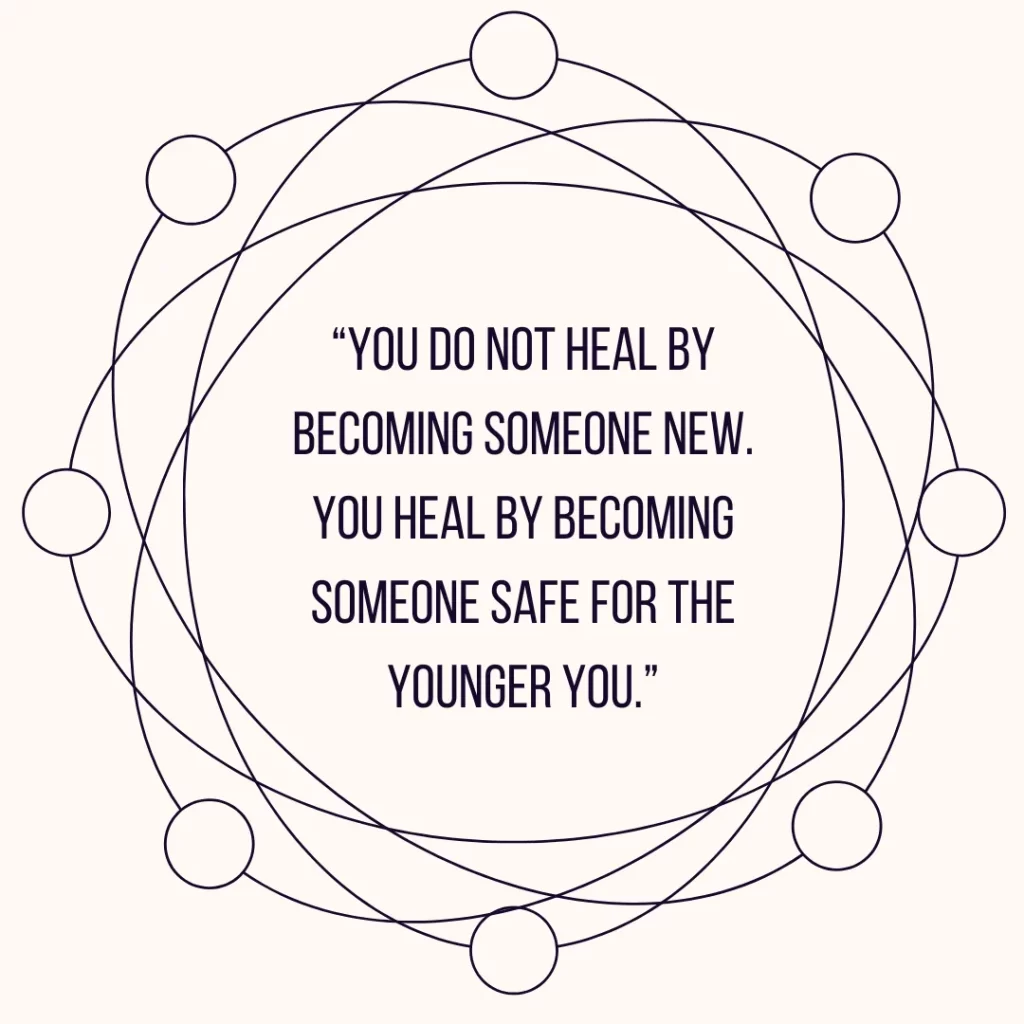
You do not heal by becoming someone new.
You heal by becoming someone safe for the younger you.
When the nervous system senses leadership, it stops preparing for harm that is no longer occurring.
Energy returns.
Clarity sharpens.
Mood stabilizes.
Metabolic health improves.
Not because you fought your body.
But because you finally led it.
Start simply.
Pause before reacting.
Tell the truth instead of pleasing.
Hold one boundary.
Stay with one uncomfortable feeling.
Validate yourself once today.
Regulation is not built through intensity. It is built through repetition.
Over time, the woman who once lived in survival mode becomes the woman whose body trusts her.
And a body built on trust is far more resilient than one built on endurance alone.
LIKE THIS ARTICLE? Share on
Facebook
Twitter
LinkedIn