
Stop Shaming Women Into Health. It’s Not Working.


Paige Elizabeth
Founder and Coach
Shame Has Never Created Lasting Health
If shame created healthy women, we would not be having this conversation.
For decades, women have been told they are too lazy, too emotional, too inconsistent, or too undisciplined to reach their health goals.
They have been instructed to eat less, exercise more, and simply want results badly enough.
Yet more women than ever are struggling with fatigue, stubborn weight, poor sleep, anxiety, brain fog, chronic stress, and burnout.
Maybe women are not the problem.
Maybe the problem is the message they have been given.
The fitness and wellness industries often assume that when a woman is not seeing results, she needs more restriction, more intensity, more discipline, or more willpower.
But for many women, especially those already overwhelmed, adding more pressure may be exactly what keeps them stuck.
Many Women Begin Their Health Journey Already Depleted
As women enter their forties and beyond, their bodies may become less tolerant of prolonged stress.
Careers become more demanding, children require attention, parents begin aging,
hormonal transitions occur, sleep becomes less predictable, and recovery starts to change.
Many women have also spent years dieting, overtraining, caring for others, and placing their own needs last.
By the time they decide to focus on their health, they are often operating from a place of physical and emotional depletion.
Then they are handed another restrictive diet, another demanding workout program,
another list of rules, and another reason to believe they are failing.
What is often overlooked is that an already overwhelmed body may not respond well to additional stress.
Your Body May Be Protecting You, Not Resisting You
When the nervous system has been living in survival mode for months or years,
adding another major stressor may make consistency more difficult.
This is when women begin telling themselves,
“I have no discipline,” “I always quit,” or “I cannot stay motivated.”
But those thoughts may not be true. Your body may not be working against you.
It may be trying to protect you.
The body’s first priority is not weight loss or fitting into a smaller clothing size.
Its primary job is survival. When it senses chronic stress, poor sleep, inadequate nourishment,
restrictive dieting, emotional overload, or insufficient recovery, it may prioritize protection over performance.
That is not weakness. It is a normal physiological response to feeling constantly under pressure.
Women Do Not Always Need More Pressure
This does not mean women should stop pursuing fat loss, strength, improved fitness, or ambitious health goals.
It means we must stop assuming that every woman needs to push harder.
Sometimes she needs more support.
Sometimes she needs more sleep, better nourishment, manageable movement,
hydration, recovery, and tools to regulate her nervous system.
You would not ask someone who is struggling to stay afloat in the ocean to immediately climb a mountain.
First, they need solid ground. Health works the same way.
Before asking the body to perform at its highest level, we must create a foundation that supports it.
That foundation includes restorative sleep, consistent nutrition, stress management,
realistic exercise, hydration, emotional support, and learning to recognize the signals the body has been sending.
Education and Compassion Create Consistency
When the right foundation is in place, energy can improve, mental clarity may return, recovery becomes easier,
and consistency begins to feel more natural.
Healthy choices require less willpower because the body is no longer fighting to survive every step of the way.
This is why women deserve more than meal plans, workout calendars, and calorie calculators.
They deserve to understand why they feel the way they do.
They deserve education about stress, hormones, recovery, the nervous system, nourishment, and lifestyle. Knowledge replaces shame.
Understanding creates compassion, compassion supports consistency,
and consistency creates lasting transformation.
Instead of asking, “Why can’t you stick to the plan?” we should ask, “What is your body trying to tell you?”
Health Is Built Through Partnership, Not Punishment
The conversation around women’s health must evolve.
Instead of assuming that every plateau is caused by laziness, we should become curious about sleep,
stress, nourishment, recovery, and resilience.
Instead of telling women to push harder, we should first ask whether they are already carrying too much.
Your body is not your enemy.
It is not broken, betraying you, or trying to sabotage your progress.
It is communicating with you.
Women who experience lasting transformation are not always those with the strongest discipline.
They are often the women who stop fighting themselves long enough to understand what their bodies have been asking for.
If we truly want healthier women, we must replace criticism with curiosity, punishment with education, and shame with support.
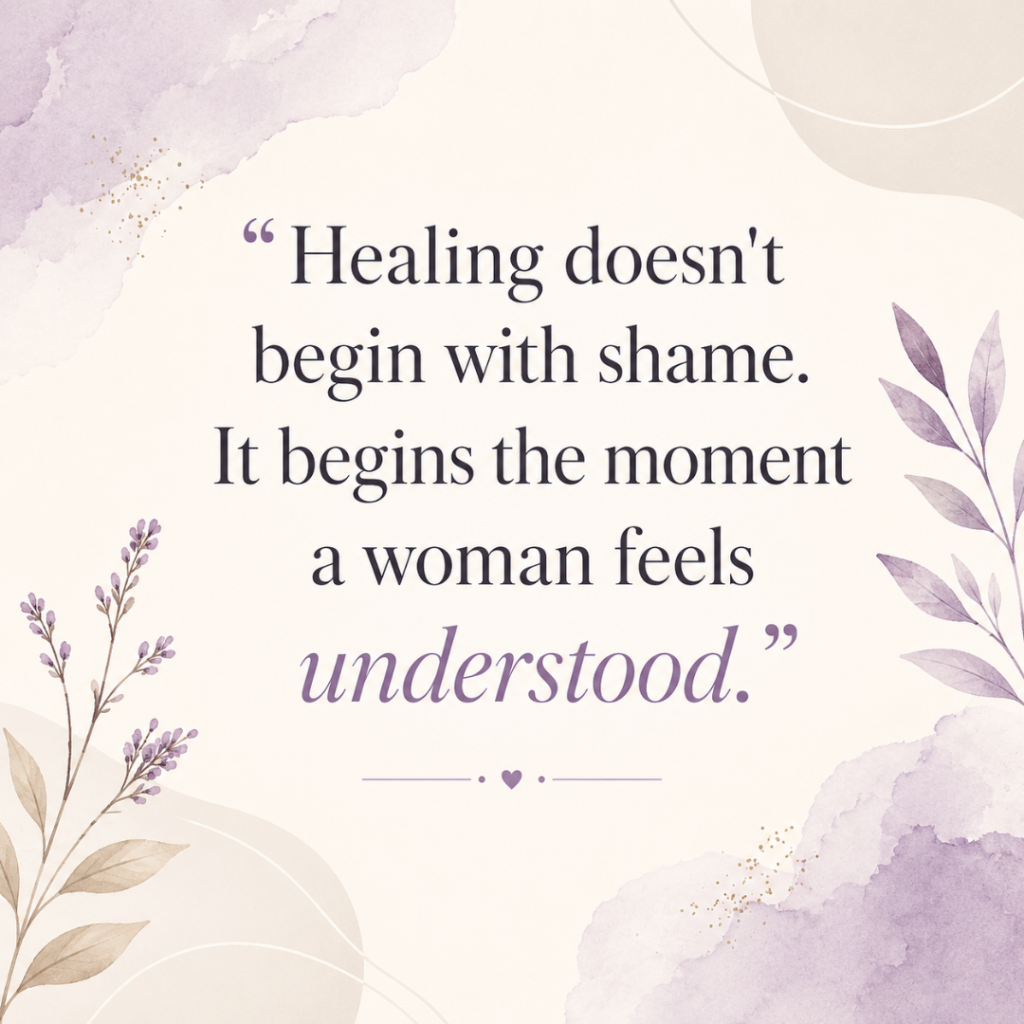
Healing does not begin when a woman feels ashamed of herself. It begins the moment she feels understood.
Ready to Create a Health Plan That Supports You?
You do not need another plan built around punishment, restriction, or shame. You need an approach that considers your body, nervous system, lifestyle, stress levels, and personal needs.
Book a free discovery call to explore a healthier and more sustainable path forward.
LIKE THIS ARTICLE? Share on
Facebook
Twitter
LinkedIn